To start off, we have major good news! On January 30th, the Federal Court of Appeal confirmed that the federal government can continue to treat plastic manufactured items as toxic under the Canadian Environmental Protection Act (CEPA).
What does this mean in practice? It means Canada keeps a powerful tool to regulate plastics across their entire life cycle, from cradle to grave, from production to disposal.
For CAPE, this decision is a major win for public health and prevention. Why? Because physicians see firsthand how plastic chemicals are linked to cancers, reproductive harms, cardiovascular disease, and immune system impacts. Microplastics have now been found in human blood, lungs, placentas, and newborns, which underscores why precautionary action matters.
So this isn’t just good news for the environment; it’s good news for our health. As Jane McArthur, our Toxics Program Director, puts it so well: ‘By upholding listing plastic as toxic under the Canadian Environmental Protection Act (CEPA), the Court has preserved a vital tool that respects our right to a healthy environment and can help prevent harmful exposures stemming from the life cycle of plastics.’
As a matter of fact, 91% of people in Canada want the federal government to take a more precautionary approach to plastics according to a recent survey.*
CAPE allied with several environmental groups as interveners in support of the Canadian government’s efforts to fend off the industry-led attempt to overturn the listing.
- Read the full joint press release here
- Read the court decision here
- See CAPE’s LinkedIn post on the ruling
- Read CBC’s coverage for more context
- *Find the Abacus Data survey, commissioned by Oceana Canada.
So where do we head from here in 2026?
As we begin a new year, we are taking stock of what we accomplished in 2025, reflecting on lessons learned, and setting our sights on the work ahead.
As always, the CAPE community approaches this work with hope and optimism, both grounded in evidence, and attentive to the real challenges shaping today’s policy landscape. Federal decision-making is currently dominated by economic and trade considerations. For the environmental health advocates that we are, this means ensuring that our messages are not only heard, but framed in ways that our now-government officials, in other words the decision-makers, understand: costs.
We know that preventing exposure to toxic fossil-fuel–based chemicals is not only a moral and public health imperative; it is also a sound long-term investment that reduces health-care costs, strengthens communities, and advances human rights.
That is why, this year, CAPE’s Preventing Toxic Exposure Program will continue to elevate a physician-driven narrative: fossil fuels are at the centre of a growing toxic exposure crisis that threatens the health, rights, and futures of communities across Canada. Whether the focus is PFAS “forever chemicals,” pesticides, petrochemicals, tar sands tailings, fracking, plastic-derived toxics, or broader fossil-fuel–driven pollution, these issues form a single story. And that is, the story of how fossil-fuel driven toxics impact us, and our public health, from cradle to grave across air, water, soil, products, and bodies.
To remain relevant with today’s decision-makers, we will continue to demonstrate that addressing toxic exposures is not only the right thing to do for our environment, our public health, and health equity, but that it also makes clear economic sense for governments, health systems, and industry alike.
And now, let’s celebrate what we have been up to in 2025:
Turning physician voices into concrete policy pressure
Policy change is built through steady pressure, credible voices, and being in the room at the right time. This fall, CAPE was very much in the room. As part of the Coalition for Action on Toxics (CAT), we’re helping shape the coalition’s 2026 priorities, building on hard-won successes like influencing updates to the Canadian Environmental Protection Act (CEPA).
That long-term work showed up tangibly on October 8 in Ottawa, where CAPE co-sponsored a packed MP reception focused on protecting health from plastic pollution and toxic chemicals. Physicians’ voices were front and centre: CAPE produced and circulated an urgent call to action from doctors, alongside a joint ENGO manifesto. The message was simple but powerful: pollution prevention is health prevention, and Parliament needs to act accordingly when it comes to toxics.
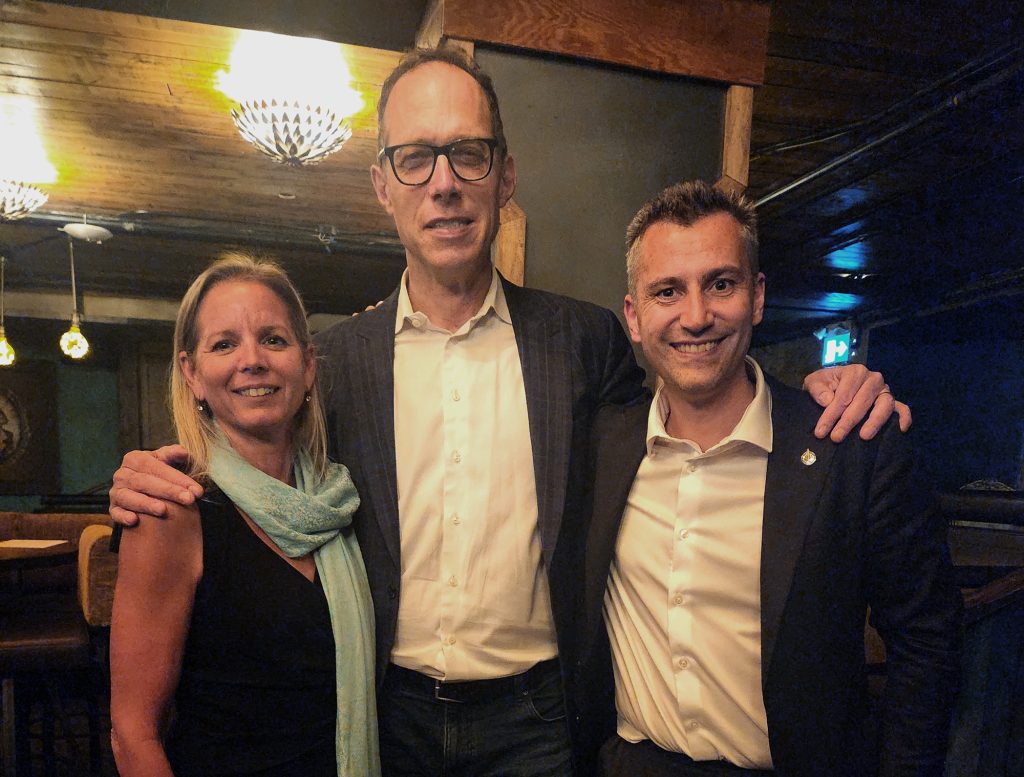 Jane McArthur, CAPE’s Toxics Program Director, with Rick Smith (President of Canadian Climate Institute and executive producer of Plastic People) and Eric St-Pierre (MP – Honoré-Mercier, Quebec) at a “Tackling Plastic and Toxic Pollution” reception last October.
Why plastic pollution is a public health issue, not just an environmental problem
Plastics are often framed as an environmental issue only, or a waste problem. CAPE helped reframe them as what they truly are: a public health issue.
Dr. Helen Hsu’s op-ed in The Hill Times laid this out plainly. Plastics and ‘forever chemicals’ (PFAS), she argued, are inseparable from toxic exposure, chronic disease risk, and mounting health system costs. Her message to the federal government was direct: investing in Canada’s health means stopping subsidies to polluters and eliminating harmful plastics and chemicals at the source.
When physicians speak clearly about upstream causes of illness, policymakers should listen.
Pushing policy to catch up with the science on “forever chemicals”
PFAS are everywhere: in water, in consumer products, and increasingly, in human bodies. CAPE spent the fall pushing to make sure regulation catches up with science.
In November, we submitted detailed recommendations to the federal consultation on PFAS, calling for stronger, more comprehensive controls. At the same time, CAPE was active within the Green Budget Coalition, supporting recommendations for permanent funding of the Chemicals Management Plan (CMP) under CEPA and the creation of an Office of Environmental Justice.
As 2026 budget recommendations take shape, CAPE’s toxics priorities are embedded in these discussions and ensuring PFAS (and all chemicals that are bad for our health) regulation isn’t treated as a niche issue, but as a foundational public health measure. Some policy changes sound technical until you look at their health implications. Think of pesticides for example!
Why weakening pesticide oversight puts health at risk
Pesticides are in our food, plain and simple. We already have France criticizing Canada’s lentils because of the pesticides we use, and that’s only one example. When the federal government proposed eliminating cyclical pesticide re-evaluations, CAPE joined partners in sounding the alarm. A joint letter to Health Minister Mark Holland warned that weakening post-market reassessment under the Pest Control Products Act (PCPA) would erode one of the few safeguards ensuring pesticides remain “acceptable” as evidence evolves.
For physicians, the concern is obvious: outdated approvals don’t protect patients, especially children and farm workers. CAPE’s intervention reinforced a basic principle of preventive medicine: if the evidence changes, policy must change too.
Connecting climate, chemicals, and health for the next generation
Training the next generation of health and environmental leaders is part of prevention work. And Jane McArthur, our program’s director, abides by this principle.
This year, CAPE brought the health story of plastics and toxics into university classrooms from UBC’s Planetary Health Emergency course to students at the University of Windsor’s School of the Environment. The message connected fossil fuel extraction, chemicals, climate change, and health outcomes into a single, coherent narrative.
Beyond campuses, CAPE also joined community education efforts, including the Friends of Tecumseh Forests Fall Speaker Series, sharing resources on urban biodiversity, toxics prevention, and public health. These spaces matter: they’re where future clinicians, planners, and advocates first make the connections between environment and health. CAPE produced a document on the importance of urban biodiversity and toxics prevention to public health.
Challenging fossil fuel projects that put communities’ health at risk
Toxic exposure doesn’t happen in isolation: it’s embedded in Canada’s fossil fuel infrastructure, from cradle to grave.
CAPE joined Indigenous, health, and environmental organizations in rejecting federal guidance that would allow “treat and release” of oilsands tailings into waterways. Leading Indigenous community voices and physicians amplified the message that releasing tailings without further study is unacceptable: a position echoed in national CBC coverage.
From peaceful gatherings led by Mikisew Cree First Nation to CAPE’s press release challenging governments to prove LNG expansion is safe (back in September), the message was consistent: communities should not be used as test cases for industrial risk. Health protection must come first. The toxics crisis is a public health crisis we cannot ignore.
Addressing who is most exposed, and why it matters for health equity and environmental justice
Toxic exposures don’t fall evenly and neither do their health impacts.
That is why environmental justice and health equity go hand in hand. In December, CAPE joined a broad coalition of legal, health, and environmental organizations to submit formal input to Environment and Climate Change Canada on advancing environmental justice. We also co-signed a national joint statement, backed by 51 organizations, calling for a robust strategy to address environmental racism.
For physicians, this work connects clinical reality with policy: where people live still strongly predicts what they’re exposed to, and how sick they may become.
Building collective power to protect water, land, and health from fossil-fueled toxics and climate change
In March, community leadership takes centre stage. Under our Place Based Power Project, our Fossil Fuel Extraction Campaign Manager, Dakota Norris, will participate with community leaders, knowledge keepers, scientists, legal experts, and land defenders to address the growing tailings crisis and threats to water: The Tarsands Tailings Crisis and Protecting Our Water. Hosted by Mikisew Cree First Nation and Keepers of the Water, the gathering will create space for learning, shared strategy, and collective action grounded in lived experience and Indigenous leadership.
Mobilizing! The need to map toxic exposure so no community is left unseen
The Canadian Coalition for Environmental and Climate Justice (CCECJ) is building a national picture of communities living near polluting industries and toxic facilities. This work depends on local knowledge: physicians, advocates, and community partners who know which neighbourhoods are bearing the burden.