Sharon: I am a full-time family doctor practicing in Richmond, BC, a mother of three teenagers, and a committed advocate fighting the harms of plastic pollution on human health and our planet. For those who feel hopelessness about this environmental disaster, I want you to know that the momentum to tackle this problem is building and history books will write about this time.
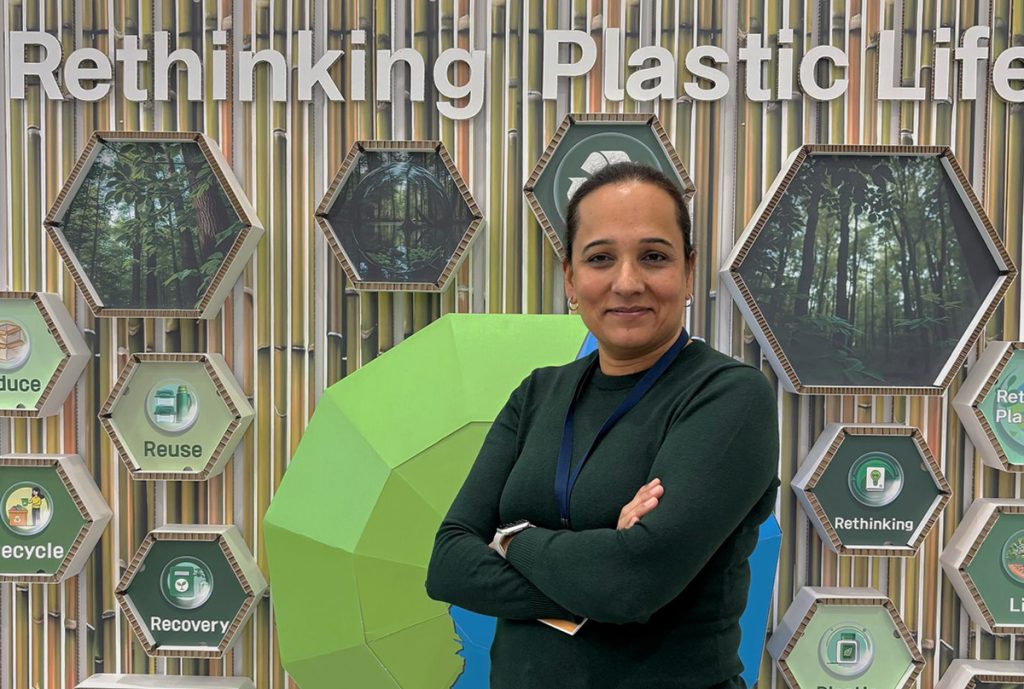 Dr. Sharon Dodd at the Rethinking Plastic Life expo during INC-5
Sehjal: I am a CAPE board member, family physician, and public health resident physician with a focus on health, public, and environmental policy in Ottawa, ON.
Dr. Sharon Dodd and I had the opportunity to attend the fifth session of the Intergovernmental Negotiating Committee (INC-5), which had a goal of finalizing an international, legally binding treaty on plastic pollution. We were on the ground representing the health community from November 25th to December 1st, 2024 in Busan, South Korea. The task ahead of the delegation of government negotiators was daunting, and our roles as civil society observers was new to us. When I returned home, it felt like my understanding of governance, international negotiations, and geopolitics was divided into before and after South Korea.
Sharon: I felt a sense of hope while attending INC-5. The majority of those in attendance came with sincere intentions. In addition to negotiators from 176 nations, there were hundreds of observers from non-profit organizations from all around the world. I was inspired by the genuine commitment of the civil society observers. The objective to build a plastics treaty that reflects the mandate set in 2022 was clear: “to end plastic pollution by addressing the full life cycle of plastics.” Most attendees understood that “health is a basic human right” and that the “plastic pollution crisis is a health crisis.”
 Dr. Sehjal Bhargava and Dr. Sharon Dodd at INC-5
Sehjal: What I was struck by most was the complexity of the task at hand. The priorities of multiple stakeholders ranging from oil rich nations to small island and developing states, Indigenous rights holders, and waste pickers were being brought to the floor and negotiated. What I had viewed as an obvious policy change in the best interest of people and planet had turned into a complicated interplay of rights, economic priorities, and politics. Health was nowhere near the center of the argument.
Sharon: There were several side events organized by nations from the global south expressing the disproportionate impacts of out-of-control plastic waste in their communities. These nations are importing large volumes of plastic waste, including textile waste, due to economic disparity, and their citizens are suffering from higher rates of health problems and ecological disasters. The statement from Panama’s negotiator, Juan Carlos Monterrey Gomez was a staunch reminder: “Every piece (of plastic) that we allow to be produced without limits is a direct assault on our health, on our nature, and on our children.”
Some of the most impactful were stories told by advocates from fence-line communities, such as Aamjiwnaang First Nation Councillor CJ Smith-White and Jo Banner, co-founder of Descendants Project, from Louisiana’s Cancer Alley, amongst others. They described horrific stories of cancer cases in their communities due to benzene and other chemicals leaking from the plastics industry.
A coalition of Canadian environmental non-government organizations (ENGOs) including CAPE, David Suzuki Foundation, Environmental Defence, Ecojustice and others played a key role in helping shape Canada’s treaty priorities. In meetings and messages with negotiators representing the Canadian government, CAPE physicians emphasized the real-life health impacts of microplastics and chemical additives to plastics. CAPE physicians were also positioned to help spread awareness of the health harms of plastics to other coalition members and observers, empowering them to explore another avenue for advocacy.
 Dr. Sehjal Bhargava (left) and Dr. Sharon Dodd (right) pose with Karen Wirsig (center) from Environmental Defence outside Busan Exhibition and Convention Center during INC-5
Sehjal: The UN process itself is not perfect. Systemic barriers to the engagement of small island states were apparent throughout—up to four breakout sessions were held at the same time discussing different parts of the treaty, and smaller countries often did not have large enough delegations to be in every room at all times, leading to a lack of representation of their interests.
Observers were shut out of meetings that were previously open door, and the backdoor, private negotiations dominated the outcomes of the meeting. Additionally, Indigenous Peoples faced barriers to having their voices heard. Despite being recognized as distinct groups with unique rights, the UN state-centric system did not create space for their perspectives to be shared in the same way sovereign states were allocated space. It was only after a public stand in support of the Indigenous Peoples Caucus that they were given two minutes to share their remarks and represent their interests on the plenary floor.
Lastly, as a consequence of the agreed upon rules and procedures of a UN multilateral negotiation meeting, the treaty approval process was consensus based. This procedural fact allowed a small number of opposing nations, notably countries with economies that centered on oil production and refining like Russia, Saudi Arabia, India, and Iran, to essentially veto the proposals brought forward from countries that were more ambitious, and ultimately prevent a final treaty from being drafted and signed. In preparation for the next meetings and to secure an ambitious treaty, organizations are having conversations about how to change to a voting-based process.
Going forward…
Sehjal: There are several environmental organizations in Canada continuing to advocate for reduced plastic production and formally regulating chemicals of concern within Canada. CAPE physicians will continue to collaborate with these partners and raise awareness of the health impacts affecting us today, impacts that will continue to worsen with unabated plastic production.
Despite coming away from this meeting without a signed treaty, significant strides were made when reflecting on what INC-1 set out to do in 2022, compared to the robustness of INC-5. For example,
- Human rights, environmental justice, and a lifecycle approach to ending plastic pollution were prioritized and woven throughout conversations and negotiations.
- More countries than ever have joined a coalition supporting bold action to end plastic production and pollution.
- Indigenous voices were included in discussions, and the principles outlined in the United Nations Declaration on the Rights of Indigenous Peoples (UNDRIP)—such as the recognition of Indigenous rights and traditional knowledge—gained significant traction. These principles are expected to play a key role in future negotiations and the final treaty text.
The treaty process creates space for discussions about the progress that can be made internationally and domestically to create a world that is unburdened by the hidden harms of what was marketed to be a safe and sterile material—plastic. For my part, I will continue to advocate for awareness of the health harms of plastics, and for an end to extractive practices and manufacturing of fossil fuel products.
Sharon: As healthcare professionals, we have a unique privilege and responsibility as a trusted voice in sharing important health related information. The same applies to raising awareness about the health harms of all types of pollution, including plastic pollution. In this effort, I have started an awareness campaign focusing on plastics, starting with the healthcare community. I organized a screening of the Canadian documentary Plastic People at the Richmond hospital on January 23, 2025. This event was made possible with the help of the Richmond Division of Family Practice and Dr. Sarah Monahan from the Richmond Hospital Medical Staff Association. There were 58 doctors in attendance, including Dr. Tim Takaro, a researcher at SFU and advocate with CAPE BC who gave a presentation about his research on the health effects of chemicals in children. The screening included a thought-provoking Q&A!
 Plastic People documentary screening at INC-5
I hope to organize similar events at other hospitals or physician meetings. As I did in Richmond, I would like to spread a message of hope by providing practical steps that individuals can take to reduce their risks from plastic exposure. I hope to inspire my colleagues to start sustainable health care projects in their practices, as plastic comprises 30% of all healthcare waste. Please read about my own office initiative at Practicing Green Care Locally.
Here are some advocacy initiatives we have been involved in:
- Sharon worked with CAPE staff to publish two op-eds in the Vancouver Sun in 2024:
- Presented “The Health Harms of Plastics” at the UBC CPD: Climate Emergency: Tipping Points for Planetary Health conference, organized by CAPE on October 26, 2024.
- Sehjal’s advocacy activities re: plastics include:
- An interview with CBC Radio: Black plastics may contain toxic compounds that can leach into food, experts say
- A press release in coalition with Environmental Defence: Groups Oppose Brampton Waste Incinerator Expansion and Demand Updates to Ontario Pollution Policy