By Kiemia Rezagian, Director of Engagement and Training
During severe wildfires in Alberta several years ago, Dr. Anna Serebrin felt helpless as a resident caring for premature babies in a NICU, inhaling smoke and stale air.
“Despite being able to control so many other aspects of the environment, we were really powerless against this,” recalled Dr. Serebrin, who is now a pediatric hematologist at the University of Alberta. “ all of these things that we can do to support sick patients, and yet something so profoundly fundamental for all of us—the air we breathe—was out of our control.”
Years later, Dr. Serebrin joined her CAPE regional committee and eventually the first cohort of CAPE’s inaugural Advocacy and Mobilization Program (AMP).
The program was transformative for her. Hearing from CAPE advocates and connecting with peers strengthened her confidence in the centrality of her role as a health care provider to advancing planetary health advocacy efforts. After AMP, Dr. Serebrin went on to create a new clerkship course on planetary health.
She credits AMP with not only solidifying for her the connection between planetary health, the health of our patients and our communities. It also helped her recognize that she and other health professionals could play an important role as advocates for planetary health.
“Having the training that I got through CAPE allowed me to feel comfortable with pursuing this, even though it seemed a little bit not related to pediatric hematology,” she said. “This was still a place, as a physician, that I could contribute to.”
In times that felt dark and heavy with gloom and despair, Dr. Serebrin’s story touched me. This work often feels like an uphill battle, and we don’t often see the results. But I had the privilege of getting to know 130 health professionals, like Dr. Serebrin, who care so deeply about others that they dedicated months of what little additional time they had, during a global pandemic, to advocate for people and the planet. And now they are championing the cause.
From 2022 to 2025, CAPE ran AMP—a capacity-building program intended to develop health professionals into planetary health advocates. Health professionals received training in storytelling, media, and government relations, learned about CAPE’s campaigns, and held 78 meetings with federal politicians. Many AMP alumni have gone on to leadership positions in the planetary health community at CAPE and beyond. It has been a great privilege to see the most wonderful and caring individuals blossom into bold and inspiring advocates, community leaders, media commentators, and more.
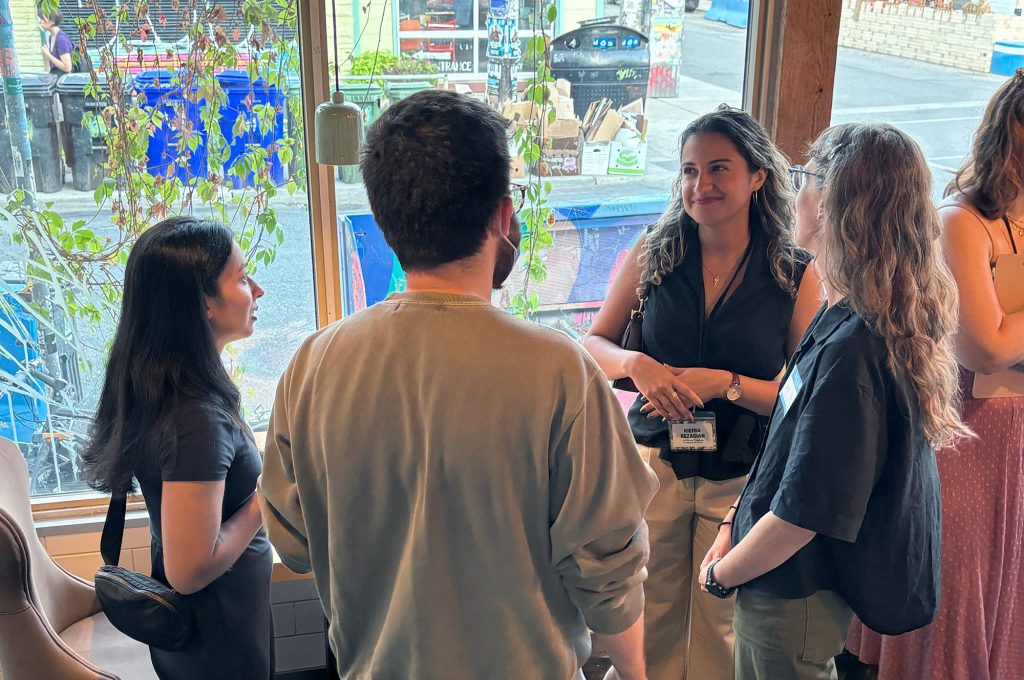 Kiemia Rezagian (third from left, in a black sleeveless blouse) chats with AMP participants at the launch event for AMP’s third cohort in Toronto, 2024.
AMP was transformative for CAPE, and we carefully monitored and evaluated our progress and learnings. We’ve published a full evaluation report here. Our report includes a detailed analysis of AMP’s theory of change, whether AMP met its outcomes (spoiler: yes), and what we learned through the process. You can check out the full report for the juiciest details, however a few things I feel very proud of include:
- AMP articulated the centrality of environmental justice to CAPE and insisted in its prioritization across our organization and campaigns. Across all three cohorts, 100% of participants agreed that their ability to apply an equity and justice lens to planetary health advocacy increased.
- AMP increased CAPE’s visibility on parliament hill and enabled important relationship-building that supported our campaigns. By 2025, CAPE was the third most active lobbying group on health in Canada.
- Cohorts became increasingly more diverse and younger, attracting a different and wider audience to CAPE.
- Multiple individuals have gone on to leadership positions across universities, health organizations, or within CAPE including as regional committee chairs; contribute regularly in the media; and/or lead local initiatives in their communities or hospitals.
What’s next?
CAPE in 2026 is very different from CAPE in 2022, when AMP began. Staff headcount has quadrupled, we have hundreds of more active volunteers, we have articulated a theory of change, and we have identified core narratives to enable social, cultural, and political change. In this new environment, we are improving our training offerings to support a growing movement of physician planetary health advocates.
A few things we’re working on include:
- Onboarding for advocates. We are developing onboarding training so that everyone who signs up for CAPE can learn about what we do and how they can be involved.
- Asynchronous training and resources. Many wrote to us wanting to participate in AMP, but couldn’t make the time commitment. We are developing material that can be accessed on your own time to improve accessibility for a wider audience.
- Indigenous Caucus. This Caucus is a convening space for Indigenous physicians, physicians practicing in Indigenous communities, and their allies to share knowledge, advocate for change, and develop advocacy strategies on Indigenous health in Canada as it relates to the environment. We are focusing more attention on building and strengthening the Caucus.
At the beginning of every AMP cohort, we’d dream of the future together. We asked each cohort to imagine: “it’s 2100, and we’ve done everything right. What does the world/life look like?”
“Every kid has nature to play in with other children right around their home.”
“A world where we value human experience and connectedness over the pursuit for power and influence.”
“The air is clean and fresh and the world is green.”
“There is more joy than anxiety.”
“There is balance in the world and all living things experience safety, health and justice.”
We are in a challenging political climate, and it feels like every morning we wake up to a new or worsening crisis. But this imagined future is not impossible. Now more than ever, we need to stick together and bring more people in. The humanity and courage of people, like the many I met through AMP, give me resolve and strength. Large corporate powers fund our division and in-fighting, and they profit off of it. We must not let them win.
We do not face an easy path, but we face it together. The future before us is messy and complicated, but it can also be more beautiful, more safe, and more free.