What have CAPE’s physicians been up to? A LOT.
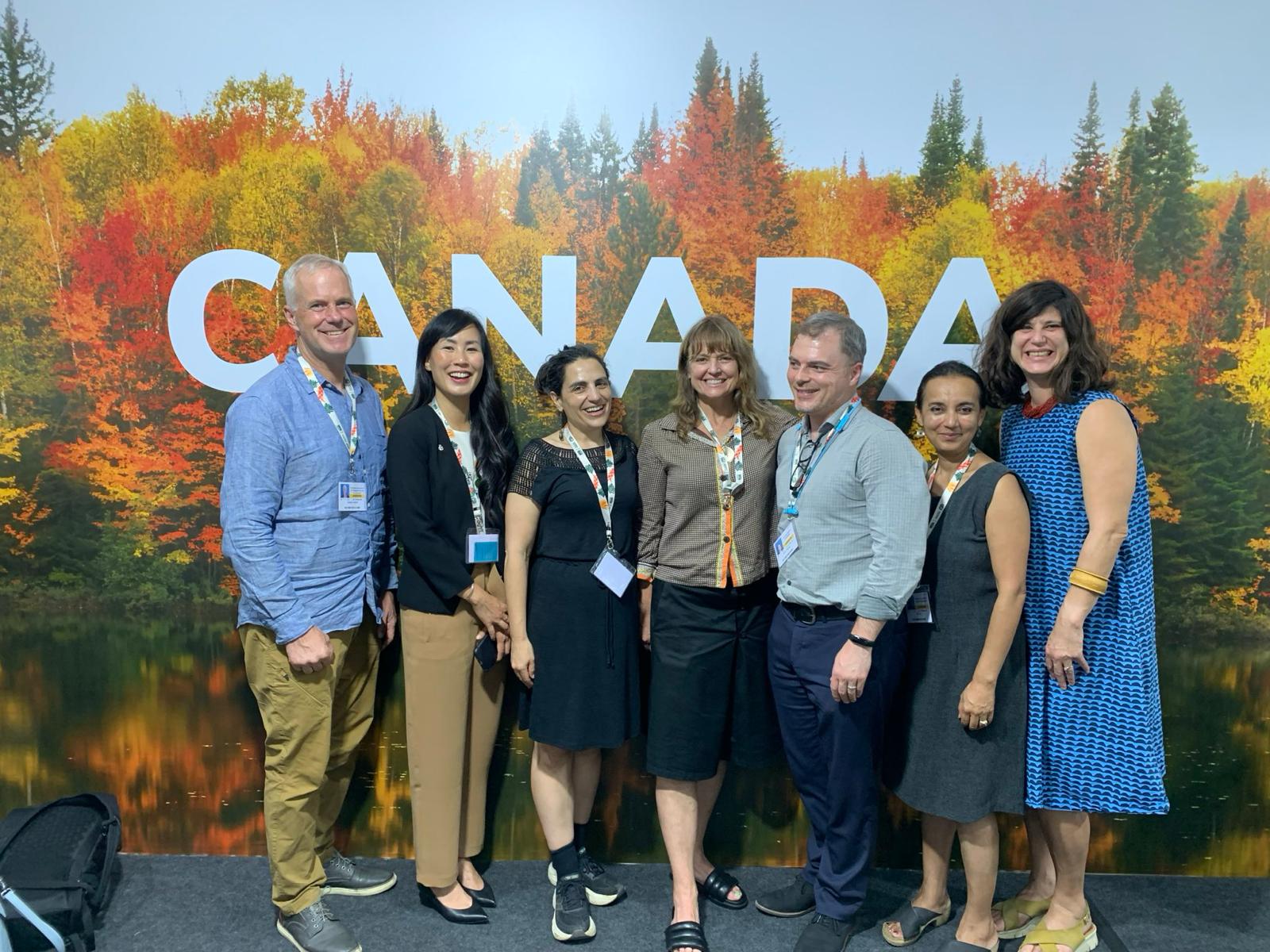
It’s been a week full of action, music, colour, and—let’s be honest—some serious collective breath-holding here at COP30. CAPE’s physicians have been everywhere: speaking, marching, giving interviews and making sure political leaders can’t ignore the health impacts of climate inaction. Dr. Joe Vipond, Dr. Melissa Lem (CAPE’s President), Dr. Mili Roy and Dr. Samantha Green have been out front, alongside Leah and Nola, the director and manager of the Health and Economic Policy team, and Robb, Climate Program Director, working closely with global health groups and meeting journalists throughout the week.
Before anything, if you haven’t seen it yet, start here: CAPE’s incredible and musical lung installation. Giant inflatable lungs were unveiled as a visual reminder that our health is quite literally in the hands of decision-makers.
So why are CAPE’s physicians doing all this? Because, as Dr. Courtney Howard put it so well, “the health costs go beyond anybody’s budget table.” Emergency cases linked to heatwaves and wildfire smoke have surged in recent years, driving chronic disease and stretching frontline healthcare workers to their limits. CAPE physicians have been witnessing it firsthand—and they tell you all about it in this video:
This powerful action was organized with the Artivist Network, while lobbyists played accordion tunes to charm policymakers—quite the scene!
In total, CAPE participated in and co-organized six panels, one press conference, and two photo-op actions—not counting meetings with policymakers and conversations with dedicated journalists. The full round-up will appear in the upcoming newsletter, but here are this week’s highlights!
What’s going well, and what’s not?
Countries are still not fully committing to leaving fossil fuels behind. The Union of Concerned Scientists delivered a powerful call, echoed by over 80 countries, demanding a concrete roadmap to transition away from fossil fuels.
Tuesday afternoon, CAPE and leading international health organizations also organized a major press conference urging countries to rapidly transition away from oil, gas and coal.
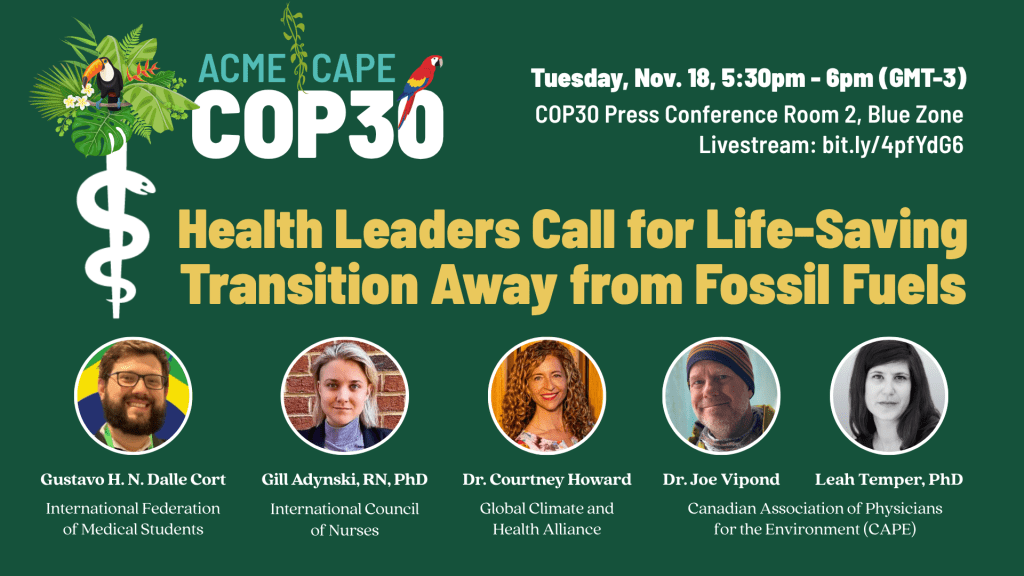
Moderated by CAPE’s Health and Economic Policy Director, Leah Temper, and featuring speakers from CAPE, the International Council of Nurses (ICN), the Global Climate and Health Alliance (GCHA), and the International Federation of Medical Students’ Associations (IFMSA), the press conference highlighted the alarming health impacts already unfolding daily.
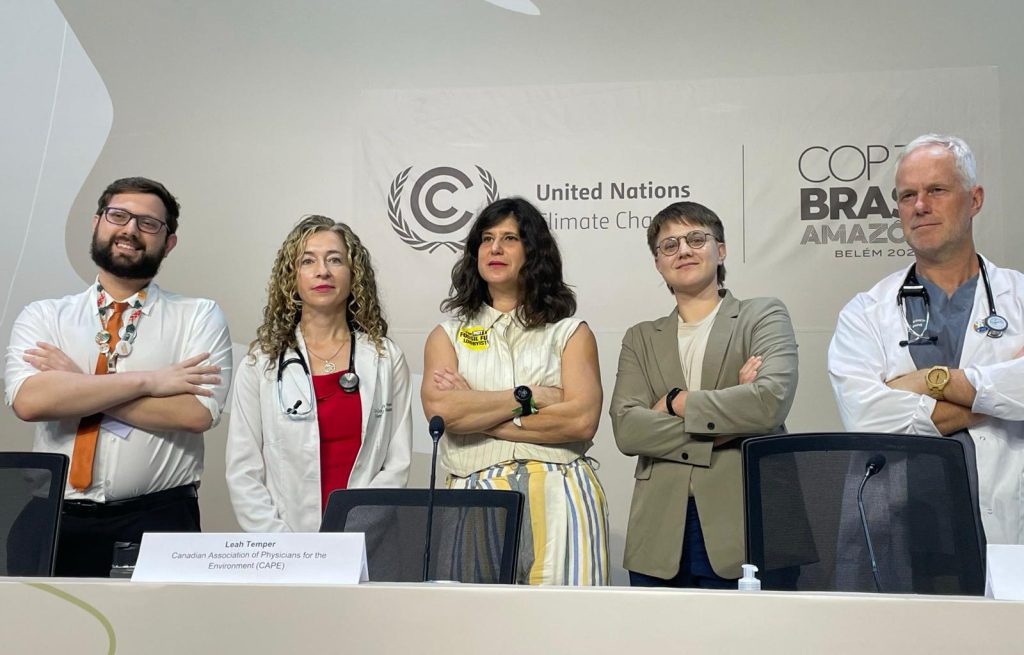
Speakers emphasized that a justice-centered commitment to transitioning away from fossil fuels—such as the Belém Health Action Plan (BHAP), Brazil’s flagship climate-health initiative launched during COP30—is essential for protecting both the climate and the communities most harmed by fossil fuel pollution. They also underscored new findings from Cradle to Grave: The Health Toll of Fossil Fuels and the Imperative for a Just Transition, which documents how fossil fuels harm health at every stage of their lifecycle.
As the International Council of Nurses reminded delegates: if fossil fuel expansion continues, our systems will be pushed past their limits. The health impacts will extend beyond direct illness to indirect harms like burned-out nurses, strained health workers, and destabilized care. You can watch the livestream here.
Press conference speakers urged COP parties to commit to a decisive roadmap to transition away from fossil fuels in line with the best available health and climate science, and to integrate health evidence into all climate decision-making, recognizing that delaying action comes at an immense and preventable human cost. And CAPE reminded the government why and how fossil fuels impact everybody’s health in this CBC interview.
So why do all of that?
Air pollution already causes over 7 million premature deaths every year; heatwaves are endangering lives and livelihoods; and climate-related disasters are pushing healthcare systems far past their limits. That is why CAPE’s physicians are on the ground.
Every day, Dr. Joe Vipond has been sharing his “COP30 Diary” videos to keep everyone updated. Here’s his latest:
Dr Joe’s COP30 diary day 8.
Fossil of the Day. The daily “award” given to the country who is seen to have done substantial harm to the climate multilateral negotiations.
Who could possibly have won it today?
1
— Joe Vipond (@jvipondmd.bsky.social) November 18, 2025 at 4:51 PM
And yes—Canada earned the “Fossil of the Day” award, with the entire EU as runner-up. Emissions haven’t decreased, the country is on track to miss its Paris Agreement targets, and its support for global progress remains… minimal, to put it kindly.
As stated in the National Observer: “As of Tuesday, 82 countries are backing a fossil fuel phase-out roadmap. Canada has yet to take a position on whether it supports a fossil fuel transition plan, or what tweaks in the proposal would be required to support it. But without political leaders on the ground to shape negotiations, the opportunity to land such an agreement is shrinking.”
This isn’t a surprise: COP30 began with Prime Minister Carney in B.C. on November 12, greenlighting major projects, including fossil fuel ones, and promoting liquefied natural gas as a “renewable, safe, and climate-friendly” energy source. Dr. Melissa Lem reminded the government that this goes directly against people’s health.
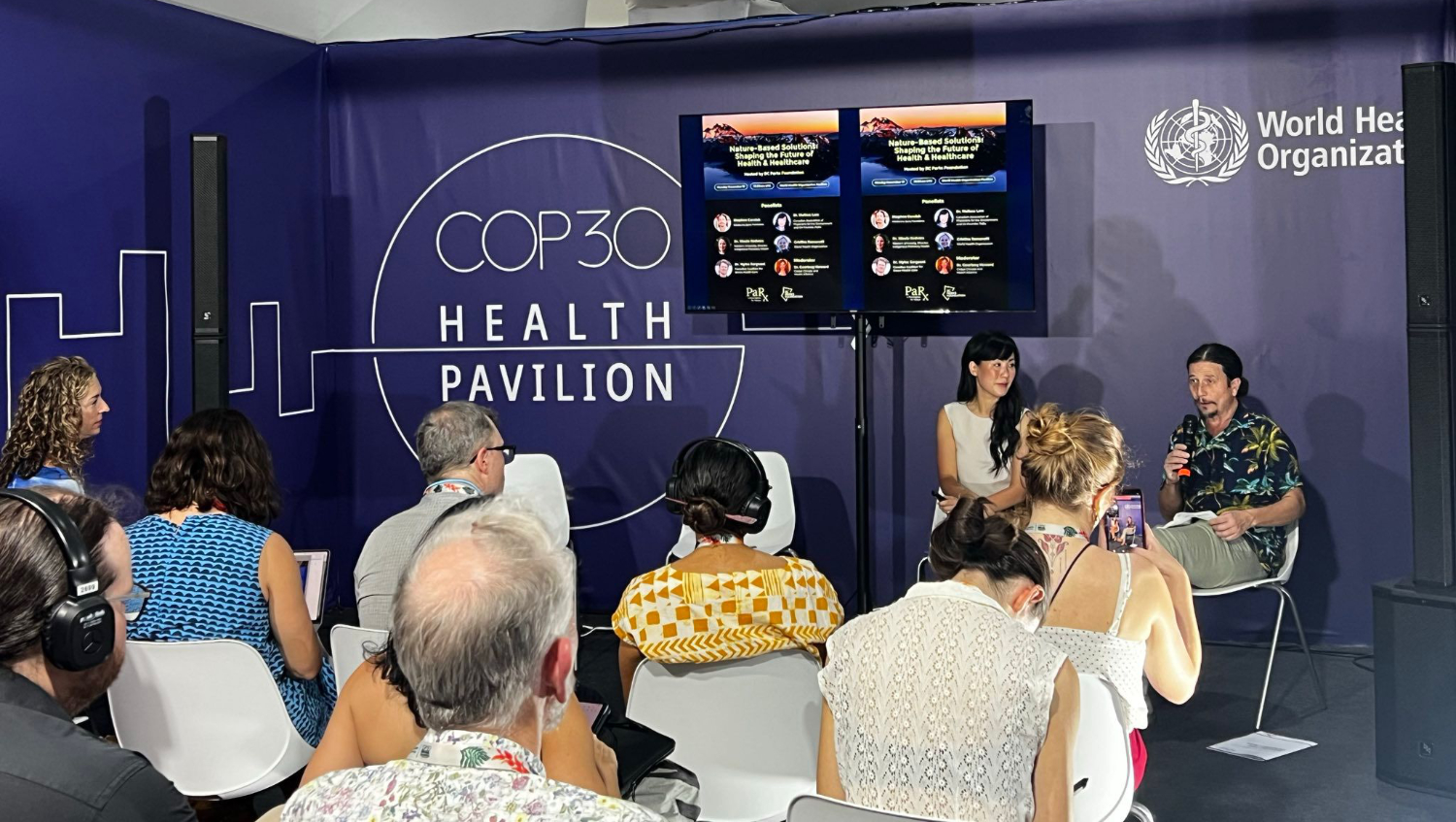
Predicting the announcement, CAPE planned a panel with climate-health experts on the importance of fighting climate disinformation:
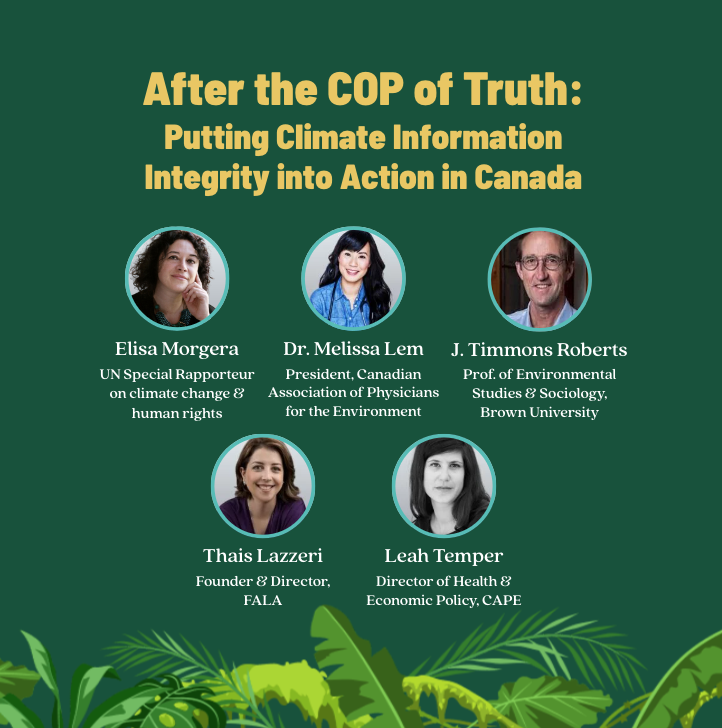
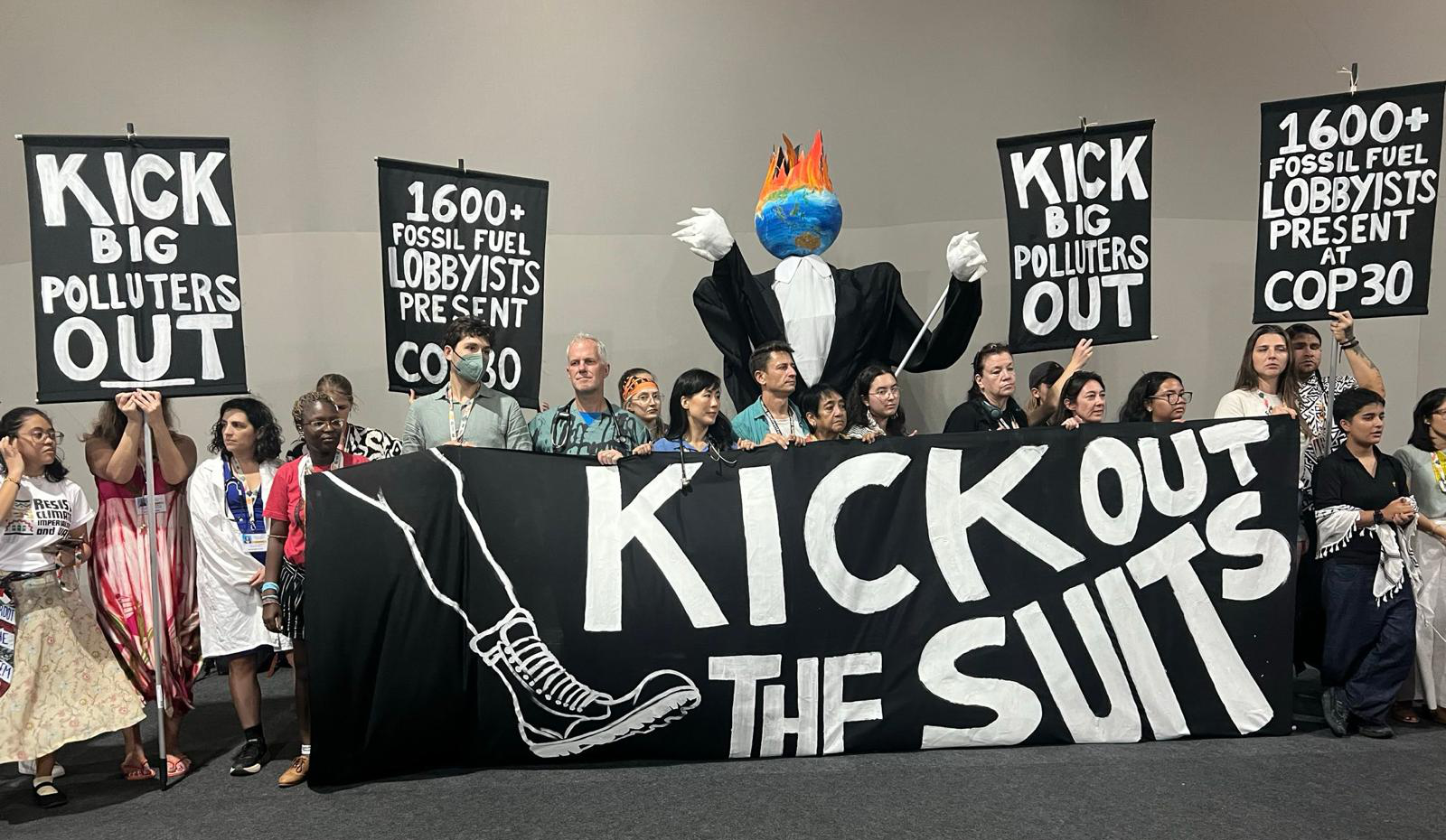
And on the same day, while CAPE physicians welcomed Minister of Environment and Climate Change Julie Dabrusin’s announcement that Canada is joining the Global Initiative for Information Integrity on Climate Change (GIICC), CAPE also signed an open letter backed by over 200 health and social civil society organizations, and spoke at the “Protect, Reform, Deliver” panel, reminding participants “in real size” that polluters have no place at COP and should be kicked out to fight climate disinformation and conflicts of interest! (More than 1,600 fossil fuel lobbyists have been granted access to the COP30 climate talks in Belém. Learn more here about the lobbyists at COPs and their influence.)
Another highlight of this urgent need to transition away from fossil fuels, commonly known as TAFF, is this morning’s panel “Health Protectors on the Frontlines of the Fossil Fuel Phase-Out,” reuniting CAPE with partners including the Athabasca Chipewyan First Nation, UBC School of Public Health, the UN Special Rapporteur on the Right to a Healthy Environment, the Special Rapporteur on Climate and Human Rights, and KlimaSeniorinnen Schweiz. The message was loud and clear: mitigation matters, but transitioning away from fossil fuels is essential. That urgency contrasted sharply with news from Ottawa this morning of Prime Minister Carney contemplating another deal involving an oil pipeline to the BC coast. The disconnect could not be clearer.
Now what?
Starting yesterday, you’ll hear closing statements and early forecasts about what the final COP commitment language may look like. As COP30 moves toward its close in Belém, civil society groups are sending a mixed but forceful message: progress is nowhere near fast enough for the scale of the crisis.
There’s cautious optimism around the new Tropical Forest Forever Facility, which many believe could reshape forest finance—if it truly directs support to Indigenous Peoples and local communities. Indigenous leadership has been especially visible, both inside the negotiations and outdoors at Brazil’s massive People’s Summit.
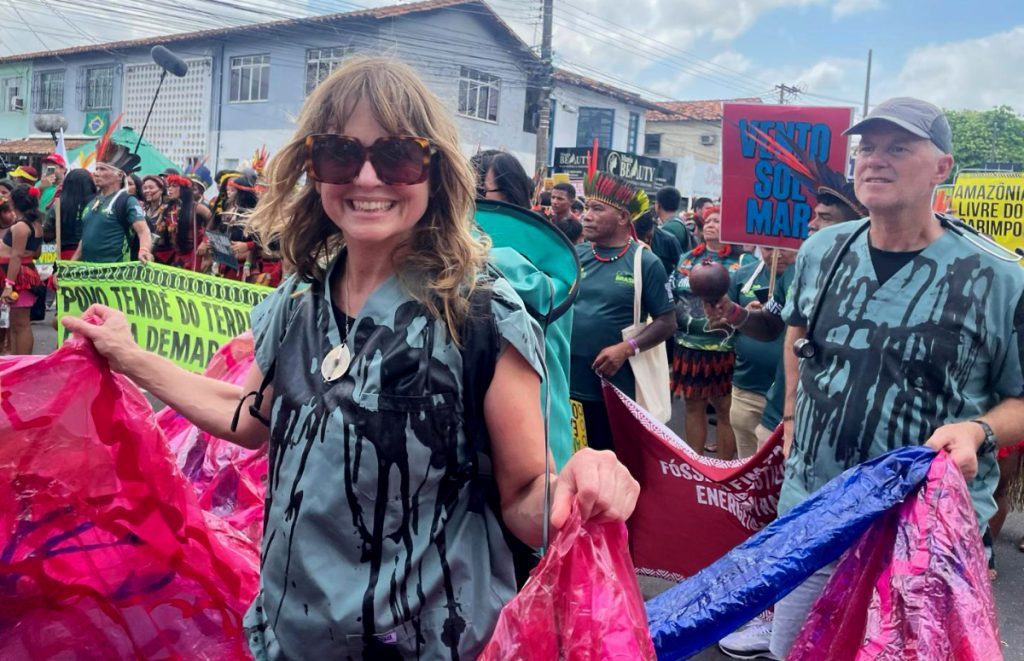
But there’s real frustration too. The draft fossil fuel roadmap is another sticking point: many see it as vague, weak, and far from what science requires. Without clear commitments to phase out oil and gas, the COP30 outcome risks becoming a symbolic gesture rather than a meaningful turning point.
Finance remains the biggest fault line. Adaptation funding is still shaky, equity gaps persist and offset-heavy market mechanisms continue to face major pushback. Indigenous and frontline communities insist that land rights, territorial protection and community-led climate solutions must move from speeches to actual commitments.
With only days left, civil society’s message is clear: COP30 has opened important doors, but real success depends on whether negotiators deliver a final agreement rooted in justice, accountability and a real transition away from fossil fuels.