A look back at CAPE’s advocacy for a historic new law
By Jane McArthur, Toxics Program Director
Advocacy and social change tend to have long time frames for achieving tangible outcomes. Often, we are so immersed in the work and the smaller cultural shifts that we forget to take stock of what has been accomplished, what has changed, what improvements were made, and the number of people involved in bringing changes to fruition. It’s important to pause, reflect and celebrate – not only in recognition of the achievements but also for the necessary energy that comes from experiencing and sharing the joy of these moments!
The final words of an op-ed co-written by CAPE Board Member Dr. Ojistoh Horn provided both a cautionary note and a strong impetus for action on environmental racism and injustices: “Indigenous and racialized people are the proverbial “canary in the coal mine”, and their health trajectory will inform how well human-kind will fare in the concurrent climate and biodiversity crises.”
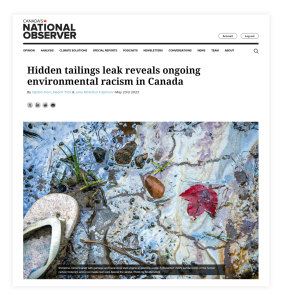
The commentary, published in May 2023, was written in the wake of the toxic leak from tar sands tailing ponds the year before. The incident was highlighted as an example of environmental racism and a call for the passage of Bill C-226 An Act to Redress Environmental Racism and Advance Environmental Justice, a starting point for a strategy for environmental justice in colonially named Canada.
Sweet Victory!
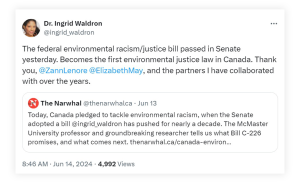
A little more than a year later, we are celebrating a historic win with Canada’s first environmental justice law. On June 20, 2024 Bill C-226 received Royal Assent. The news release from Environment and Climate Change Canada the next day reinforced government support for the bill noting “the commitment in the “Minister’s mandate letter to introduce legislation to develop an environmental justice strategy and examine the link between race, socio-economic status, and exposure to environmental risk.” We applaud the government for its role in this significant development.
Years of advocacy by many individuals, community groups, organizations and coalitions were key to this win.
Background
Bill C-226 mirrors a bill that was first introduced as Bill C-230 in February 2020 as a private member’s bill by MP Lenore Zann. With the election call in 2021, the bill died on the order paper, then,on February 2, 2022, Green Party MP Elizabeth May reintroduced the bill as Bill C-226, and it subsequently garnered government support.
MP Zann’s original bill was informed by Dr. Ingrid Waldron’s research on pollution in Black and Indigenous communities in Nova Scotia. Dr. Waldron co-founded the Canadian Coalition for Environmental and Climate Justice (CCECJ) with Naolo Charles a coalition made up of many individuals, community groups and ENGOs including CAPE. Dr. Waldron has been a leading voice, a force for bringing people together in support of the bill and a powerful advocate through all the stages of the bill from start to finish. The solidarity in the environmental justice movement in Canada has undoubtedly been nurtured by Dr. Waldron and the existence of the CCECJ which was particularly powerful in moments when the success of the bill becoming law was in doubt.
The CAPE Voice
I have been reflecting on the passage of Bill C-226 – seeing many messages, articles and posts acknowledging the work behind the bill over these past weeks. I am inspired by, applaud and thank the many advocates who have been crucial to this historic new law. It was not a smooth path – there was resistance and challenges to the bill and to the idea that environmental racism exists in Canada. Shifting the narrative was a long slow process and CAPE was there to advance stories and knowledge that contributed to this shift.
CAPE BC hosted a series of three webinars in April and May of 2021, entitled Environmental Justice x Health. Current CAPE Board President Dr. Melissa Lem kicked off hosting this series and over the course of the three events, the issue was powerfully addressed by CAPE physicians Dr. Ojistoh Horn, Dr. John O’Connor, Dr. Warren Bell, and Dr. Margaret McGregor. They were joined by advocates including Dr. Ingrid Waldron, Sleydo’ (Molly Wickham), Elder François Paulette, and CAPE Executive Director Dr. Anjali Helferty, PhD.

Around the same time, CAPE made a submission to members of the Standing Committee on Environment and Sustainable Development (ENVI) in support of Bill C-230. Soon after we developed a campaign page to offer updates, track the progress of the bill and inspire action by the CAPE community and general public in support of the bill.
CAPE worked alongside members of the CCECJ and other ENGOs, putting energy into calling for a re-introduction of the bill when it died with the 2021 election call, signing joint letters and statements, and garnering attention from media and decision makers. We collaborated at all stages of the bill, developing strategies to ensure it would eventually pass.
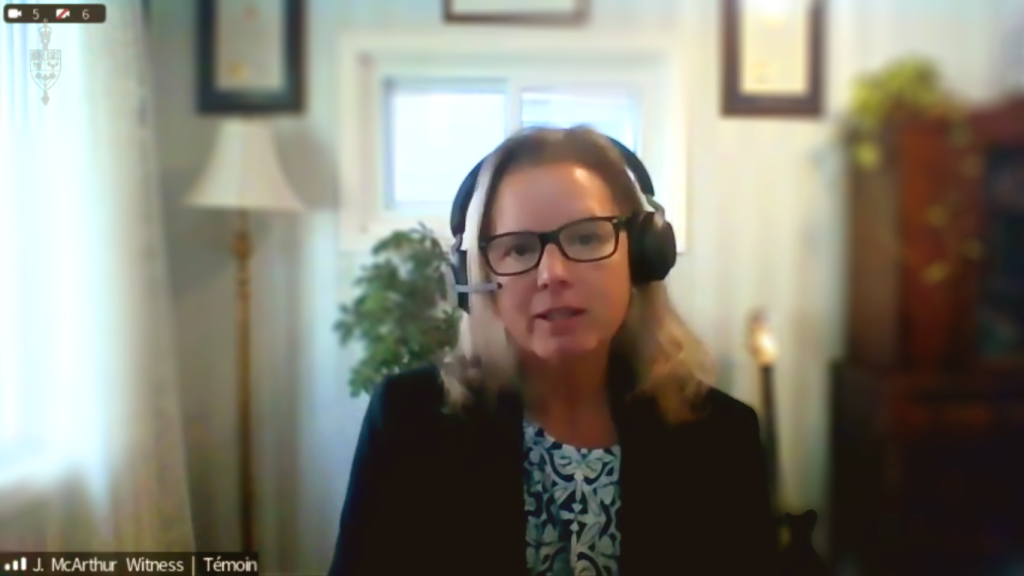
CAPE was invited to provide witness testimony before the committee in response to the brief we submitted to ENVI in support of Bill C-226 – an invitation extended with the support of MP Elizabeth May and Dr. Ingrid Waldron. I appeared before ENVI and reinforced the need for the bill from the point of view of environmental racism as a health issue.
In 2023 I reached out to the CAPE community ahead of a webinar I was presenting on where I talked about environmental racism. I heard from physicians and health professionals about their experiences, observations and knowledge while working in their communities. It was disturbing to receive messages that illustrated some of the many ways in which environmental racism and other environmental injustices were occurring. I heard about toxic water from fracking in BC, climate change impacts on Indigenous Peoples in the North, the effects of the lack of urban forests in Manitoba, tar sands tailings ponds in Alberta and the Northwest Territories, petrochemical and plastic pollution in Aamjiwnaang First Nation, air pollution, loss of traditional lands and foods, and more. I shared these insights to contribute to the narrative of the need for environmental justice, echoing the powerful refrain from Indigenous and racialized peoples and their allies.
When the bill made its way to the Senate for study, CAPE submitted a brief to the members of Standing Senate Committee on Energy, Environment and Natural Resources (ENEV), reinforcing that human health and environmental justice are intricately intertwined and swift implementation of the strategy was needed.
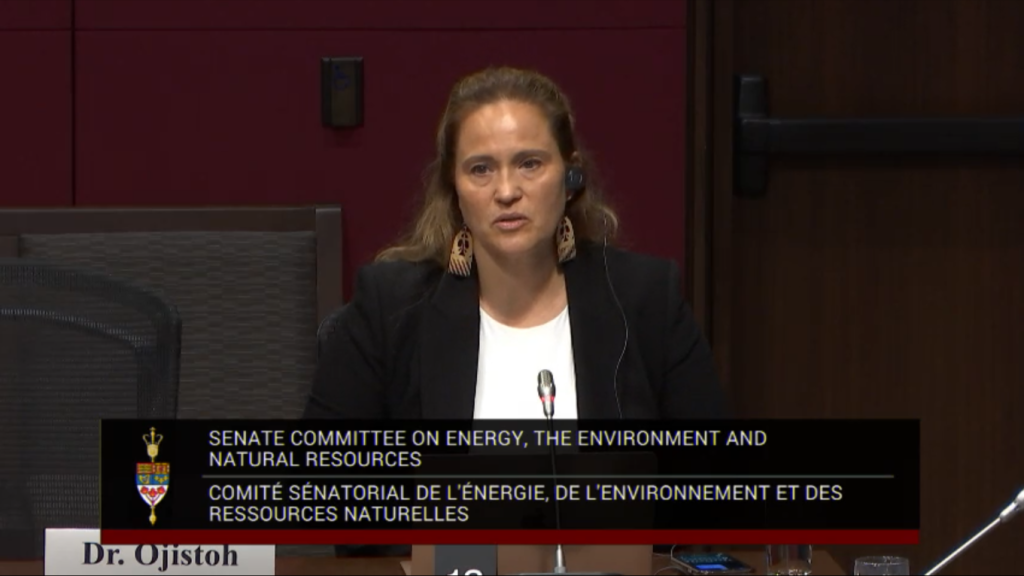
Soon after, Dr. Ojistoh Horn appeared before the committee as a witness to clearly articulate the problem. She stated:
“Environmental racism is the inequitable distribution of accountability. It is supported by upstream systemic factors – societal values and beliefs conforming to a capitalist economy, that humans do not have a right to a healthy environment in practice, legislation that does not fairly protect BIPOC and Indigenous communities, institutions whose siloed and competing mandates do not protect these communities and are not uniformly held accountable to the laws already in place, and programs that have been designed without input from all stakeholders.”
In the meantime, we partnered with the David Suzuki Foundation on a petition and the CAPE community joined in contributing to the thousands of signatures that were eventually delivered to the Senate calling for passage of the bill.
Next Steps and Implementation
While it is good news that Bill C-226 has passed and celebration is warranted, I hope to spur you into ongoing action as activities begin to implement this bill. We will keep you updated on moments where your voice and action can be helpful, including in our work on the Place-Based Power Project with partners Keepers of the Water, and Skeena Watershed Conservation to address the human health and social justice elements of fossil fuel extraction. You can also visit the Environmental Equity platform to add to the discussion.
As always, I invite you to reach out to me at jane@cape.ca about this issue or any of the many areas of advocacy our Preventing Toxics Exposures Program is engaged in.

Jane McArthur
Toxics Program Director